--
kt
--
gust
--
°C
--:--
UTC -4
Live
View ›

The Saint-Jean spot, activity by activity

Which wind and which swell suit each watersport at Saint-Jean Bay — the same thresholds as the dashboard recommendations.

Right now

ⓘ

Forecast

ⓘ

Last 30 days

ⓘ

Month by month

ⓘ

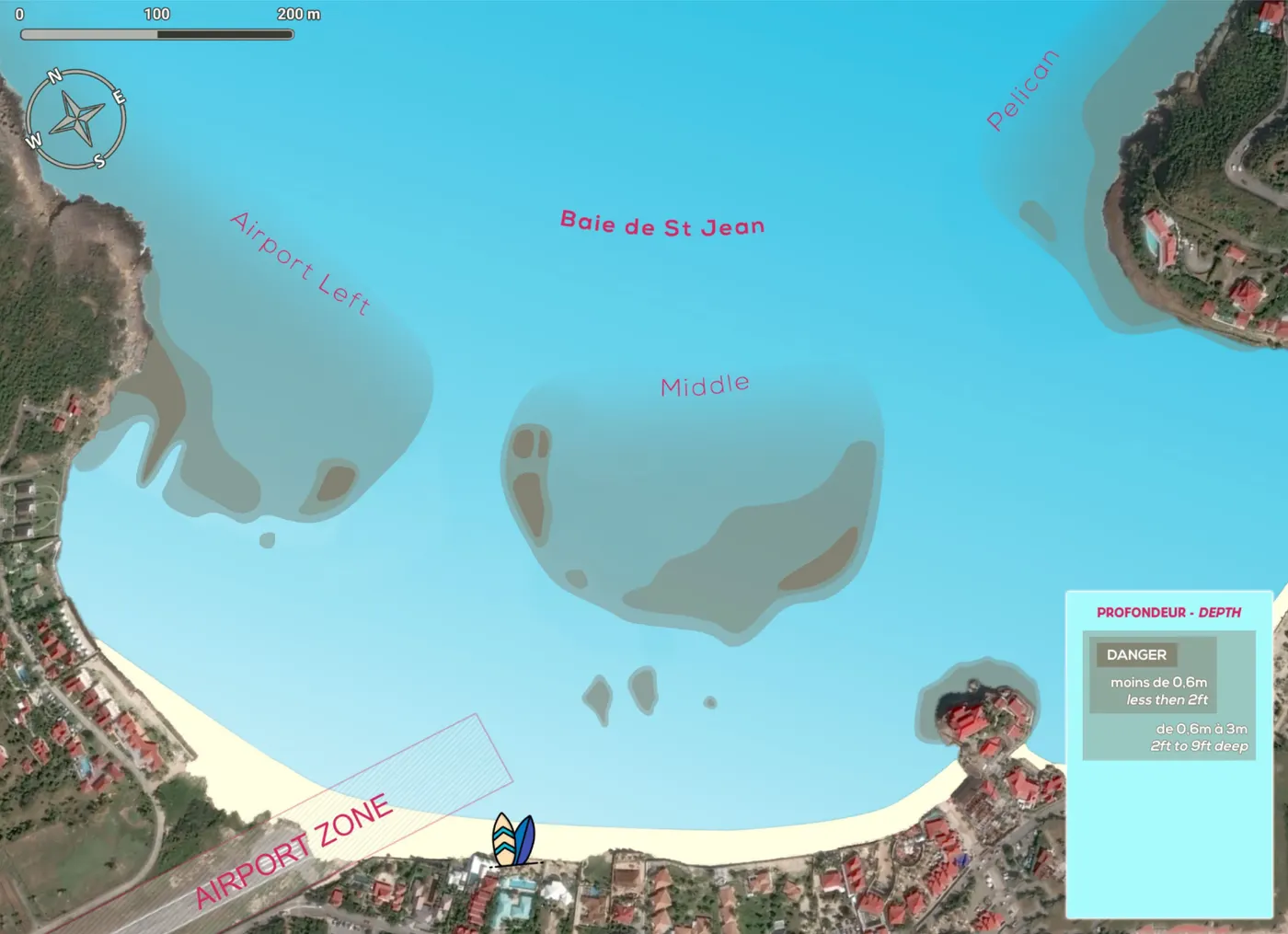
Three reefs, two passes

A line of reefs closes the bay and separates it from the open sea, from west to east:

  • Airport Left: from the western cliff to a first pass, in front of the airport.
  • Middle: the central reef, up to a second pass, wider and more sheltered, in front of Eden Rock.
  • Pélican: along the eastern cliff, it closes the bay.

On these reefs the bottom comes up in places to less than 0.6 m (2 ft) — danger zones — and stays between 0.6 and 3 m (2 to 9 ft) around them. Inside the bay, three isolated coral heads lie off the middle of the beach.

Swell coming in from offshore breaks on the reefs and loses much of its energy: outside, it arrives at full strength; inside, the water is much calmer. This is what makes the inner bay a good place to learn, even when the sea is rough offshore. It also explains the gap between two figures on the dashboard: the offshore swell in the forecast table, and the wave at the spot on the gauge, which is smaller because it accounts for the bay's shelter.

Map of Saint-Jean Bay: Airport Left reef to the west, Middle in the centre and Pélican to the east, areas under 0.6 m and from 0.6 to 3 m deep, three coral heads off the beach.
Saint-Jean Bay reef map — The reefs and their depth (scale 0 – 200 m). Darkest areas: under 0.6 m. © CaribWaterplay

Surfing: reef breaks

Surfing at Saint-Jean happens on the reefs, where the swell breaks:

  • Airport Left (or "Left"): to the west, off the airport cliff.
  • Middle: on the central reef.
  • Pélican: along the eastern cliff.
  • Coupe Gorge: bigger and more committing, for experienced surfers only.

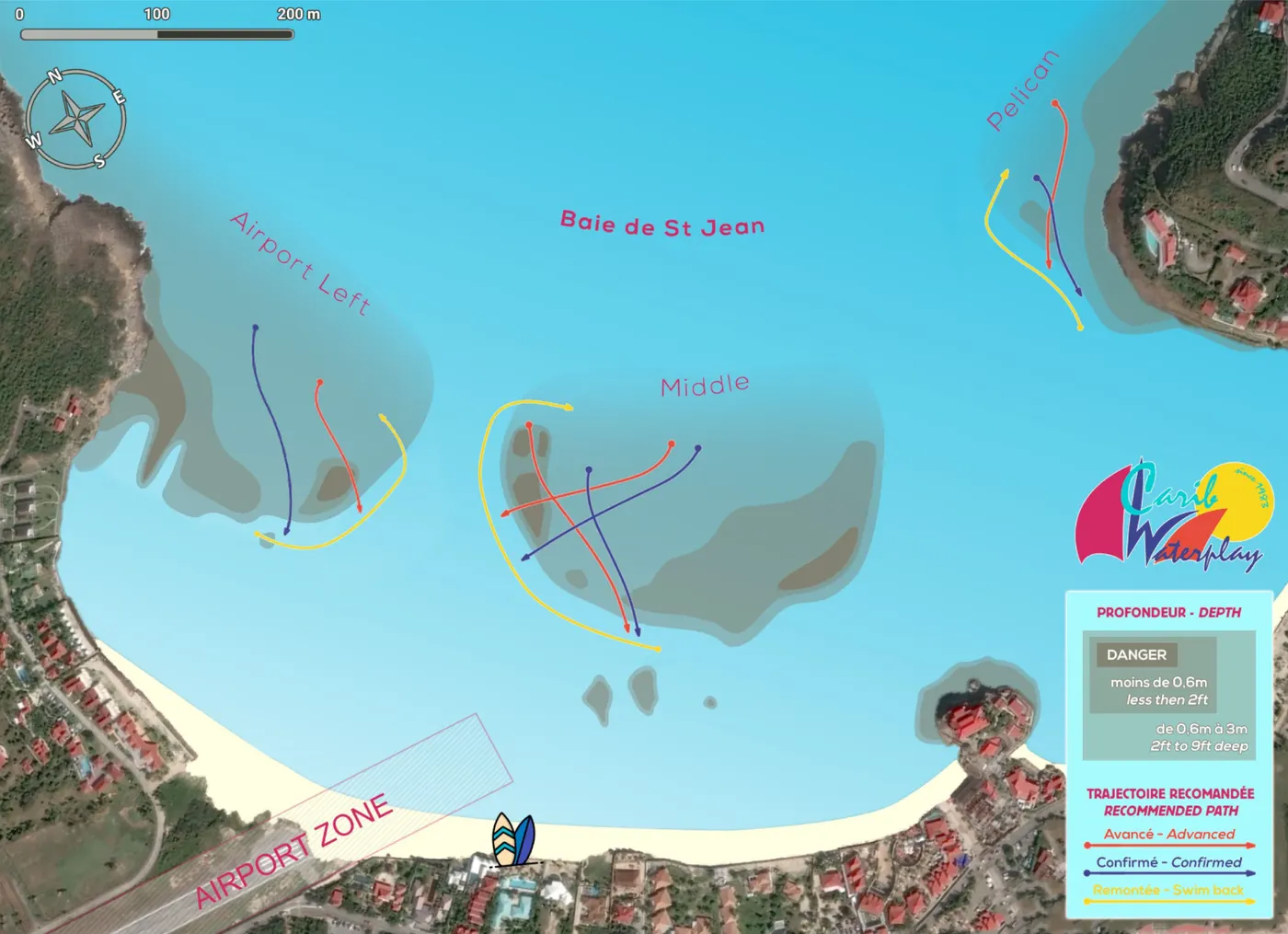
These are reef breaks, over a bottom that can come up to less than 0.6 m: follow the recommended lines for your level, paddle back to the peak through the deeper areas rather than across the impact zone, and keep an eye on the water depth, especially at low tide. North-east to east swell with a long period (11 seconds or more) works the reefs best.

SurfingProne foilPump foil

Map of the Saint-Jean surf spots: Airport Left, Middle and Pélican, with recommended lines for advanced and confirmed surfers and paddle-back routes.
Saint-Jean surf spots map — Recommended paths: advanced (orange), confirmed (blue), paddle back (yellow). © CaribWaterplay

Windsurfing and wingfoiling

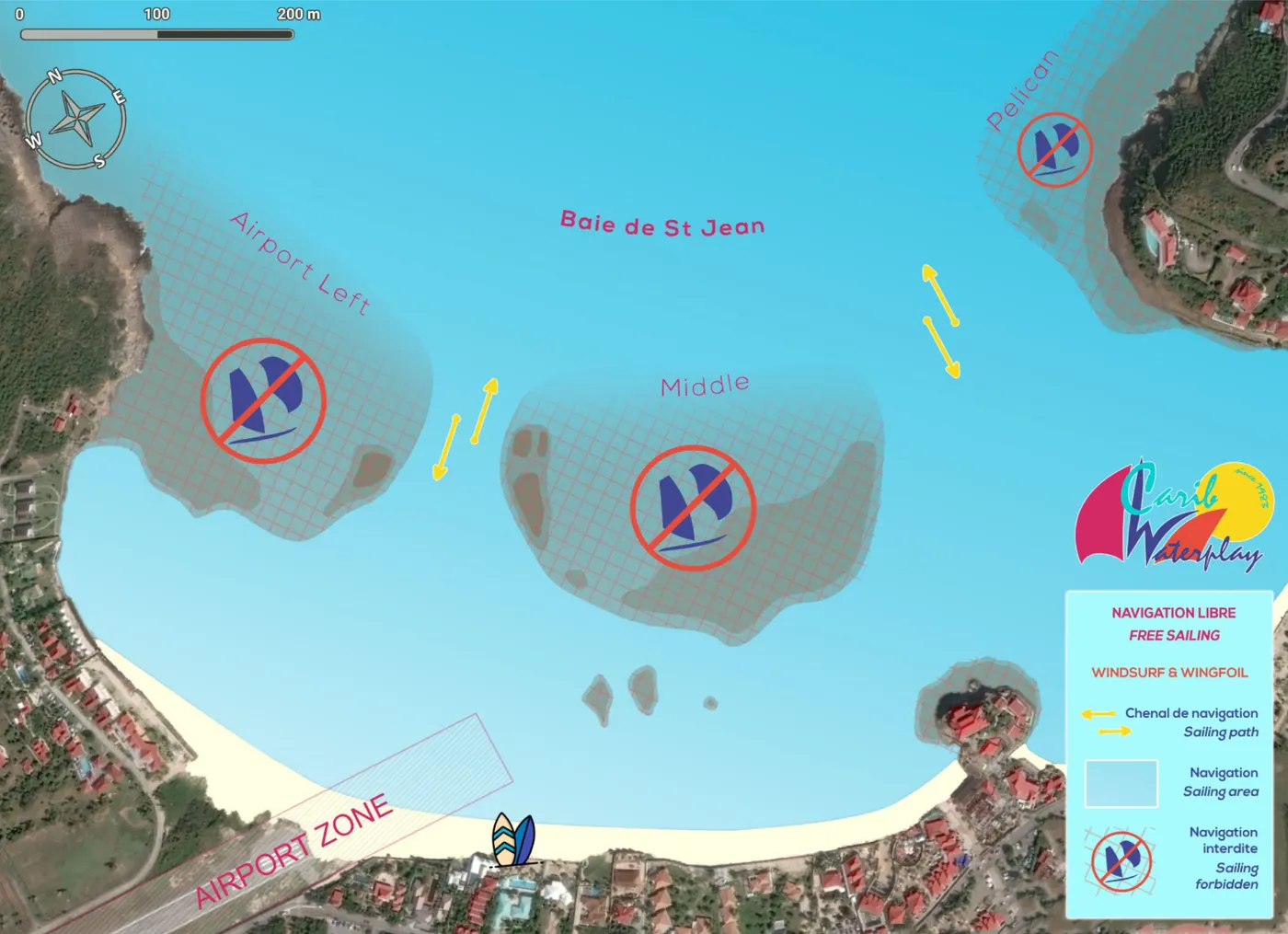
Sailing is free in the bay and offshore, except over the three reefs, where it is forbidden. To leave or come back into the bay, use the two passes: between Airport Left and Middle, and between Middle and Pélican, in front of Eden Rock.

WindsurfingWingfoil

Windsurf and wingfoil sailing map of Saint-Jean: sailing forbidden over the Airport Left, Middle and Pélican reefs, sailing paths through the two passes.
Windsurf and wingfoil sailing map — Windsurfing and wingfoiling: forbidden areas (reefs) and sailing paths. © CaribWaterplay

Catamaran

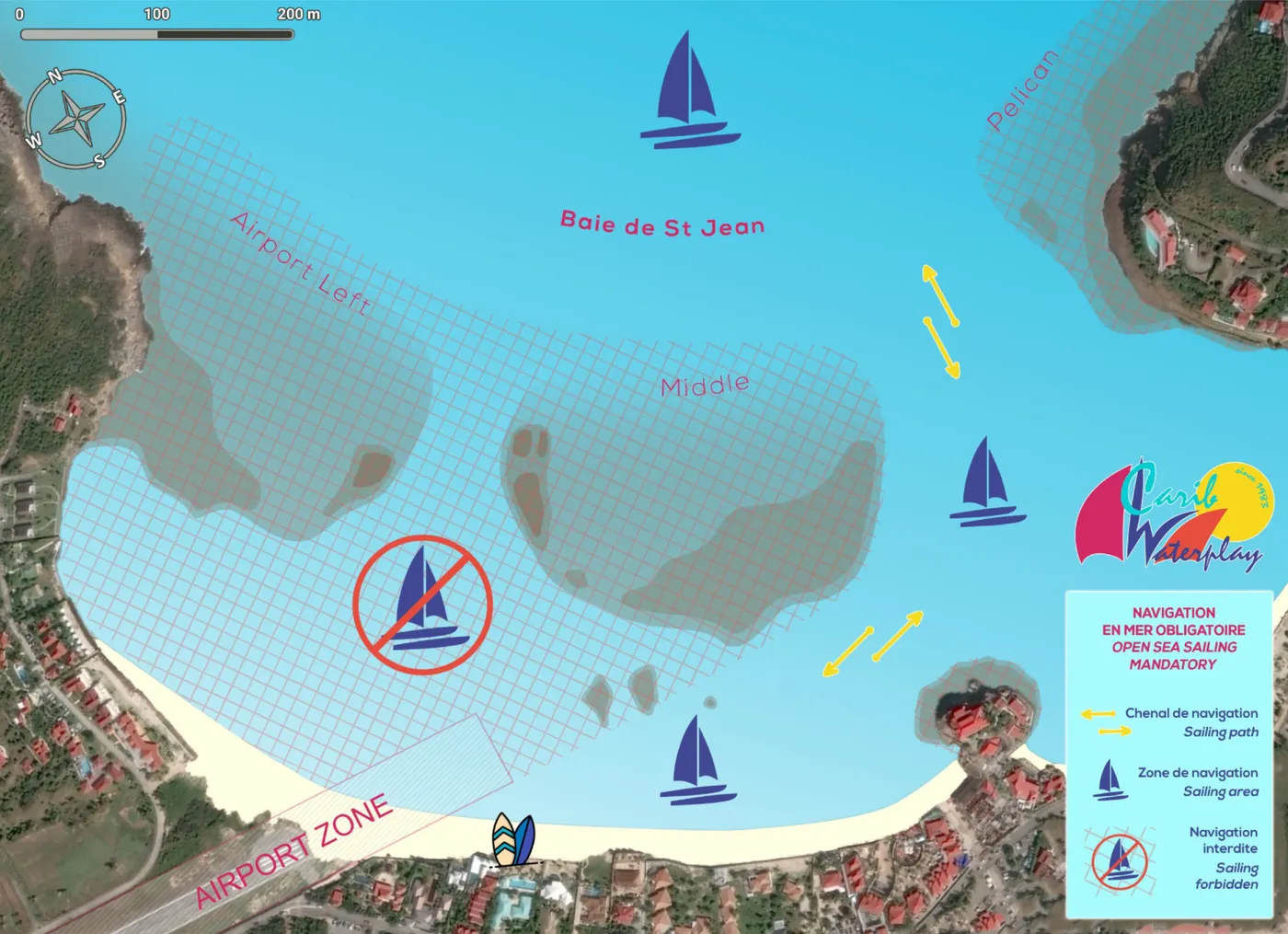
Catamarans must sail out at sea: the whole western part of the bay, reefs included, is off limits. Leave through the eastern pass, in front of Eden Rock, to sail offshore.

Catamaran

Catamaran sailing map of Saint-Jean: western part of the bay forbidden, exit through the eastern pass in front of Eden Rock, open-sea sailing mandatory.
Catamaran sailing map — Catamaran: open-sea sailing mandatory, exit through the eastern pass. © CaribWaterplay

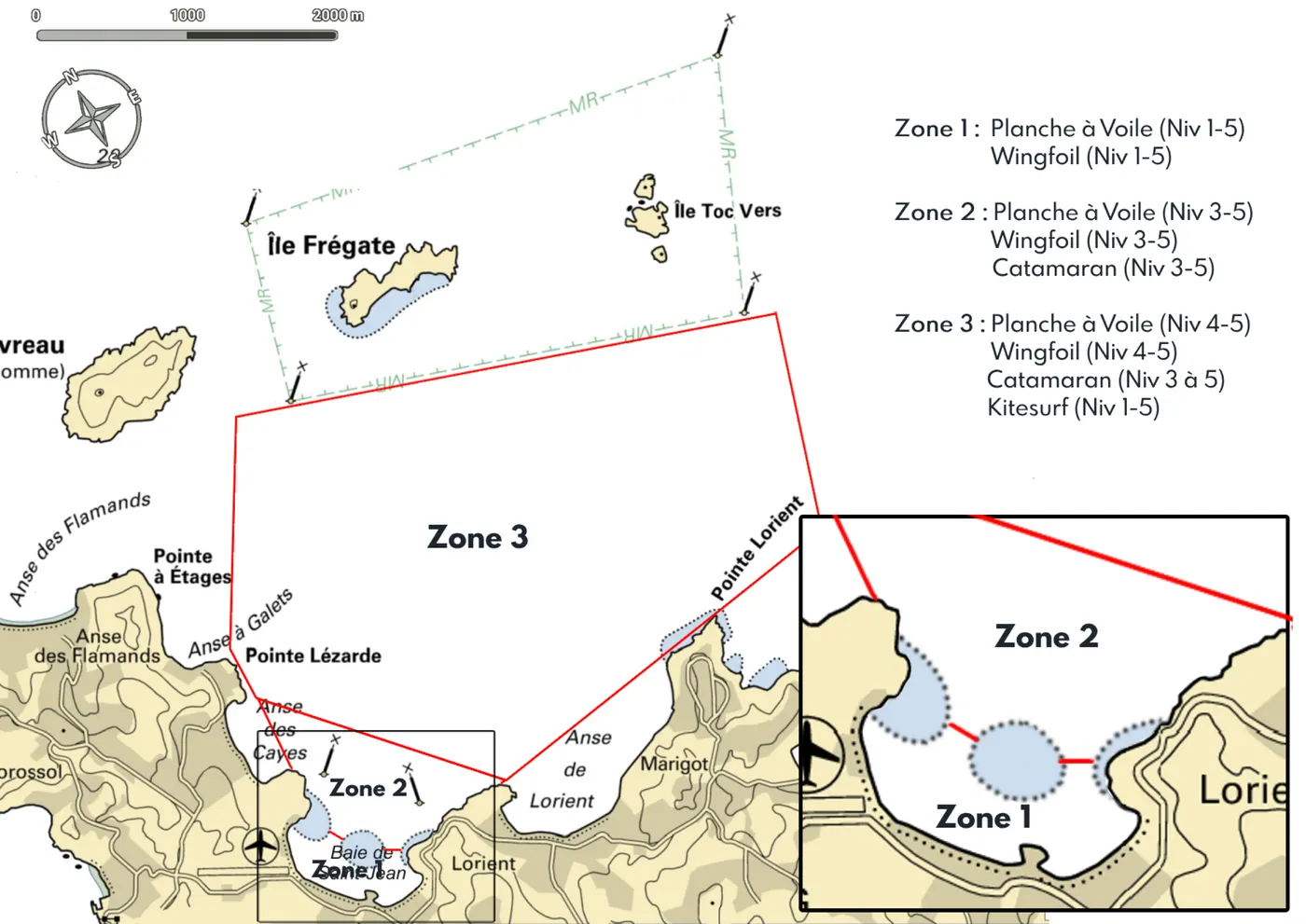
Sailing zones by level

ⓘ
ZoneWhereActivities (level)
Zone 1The inner bay, sheltered by the reefsWindsurfing and wingfoiling (levels 1 to 5)
Zone 2Beyond the reefs, up to the Anse des Cayes – Lorient lineWindsurfing, wingfoiling and catamaran (levels 3 to 5)
Zone 3Offshore, between Pointe Lézarde and Pointe Lorient, up to the marine reserve boundary around Île Frégate and Île Toc VersWindsurfing and wingfoiling (4 to 5), catamaran (3 to 5), kitesurfing (1 to 5)
Map of the sailing zones north of St Barth: zone 1 inside Saint-Jean Bay, zone 2 up to Anse des Cayes and Lorient, zone 3 offshore up to the marine reserve around Île Frégate and Île Toc Vers.
Sailing zones map, north coast of St Barth — The three sailing zones (scale 0 – 2,000 m). © CaribWaterplay

Snorkelling

The best spots to look at the seabed are the three coral heads in the middle of the bay and the reef off the Eden Rock rock. The surf reefs (Airport Left, Middle, Pélican) are only suitable for snorkelling in small swell; otherwise, stay on their edges. High tide leaves more water over the seabed, making it easier to swim without touching it.

Snorkelling

Ideal conditions, activity by activity

ⓘ
ActivityIdeal windIdeal seaGood to know
Wingfoil 16 – 22 ktup to 0.9 mWorkable from 10–13 kt with a large wing.
Windsurfing (beginner) 10 – 13 ktunder 0.6 mAbove 19 kt it is no longer a learning wind.
Funboard 16 – 25 ktup to 0.9 mFor experienced riders, in strong wind.
Catamaran 10 – 16 ktunder 0.6 mNot advised above 19 kt.
Surfing under 10 kt1.2 m and moreReef breaks; north-east to east swell, long period.
Bodyboarding under 10 kt0.6 – 1.6 mMore forgiving than surfing on wave size.
Prone foil under 10 kt0.6 – 0.9 mSmall, clean waves.
Skimboarding under 10 kt0.3 – 0.9 mAt the shoreline, short waves.
eFoil under 10 ktunder 0.6 mFlat water preferred.
Pump foil under 5 ktunder 0.3 mPerfectly flat water.
Seabob under 13 ktup to 0.9 mNot very sensitive to conditions.
Wakeboarding under 10 ktunder 0.3 mFlat water.
Kayaking under 10 ktunder 0.6 mBest in the morning, before the wind picks up.
Stand up paddle under 10 ktunder 0.3 mA headwind quickly makes the way back hard.
Snorkelling under 13 ktunder 0.6 mCoral heads and the Eden Rock reef; surf reefs only in small swell.

Good to know

Saint-Jean Bay

Saint-Jean Bay opens to the north-north-east, on the north coast of St Barth, between the airport cliff to the west and the eastern cliff. This orientation makes it a wind spot: the easterly and north-easterly trade winds blow in head-on or at an angle, and a funnel effect strengthens winds from the north-east to east-north-east.

The bay is also partly sheltered from swell: Île Chevreau (also called Île Bonhomme), to the north-west, blocks north and north-west swells, while Pointe Milou, to the north-east, lets part of the easterly swells wrap into the bay.

Favourable directions

  • North-east to east wind: the best sector for windsurfing, wingfoiling, funboarding and catamaran sailing.
  • North or south-east wind: workable.
  • South-west to north-west wind: offshore wind, unusable for sail and wing sports — it blows out to sea.
  • North-east to east swell: the only swell that really works the reefs for surfing, especially with a long period (11 seconds or more).

When to come?

The wind is on average lighter at night and in the morning, then builds until early afternoon: calm sports (kayaking, paddleboarding, snorkelling) are more comfortable in the morning, wind sports in the afternoon. For the season, see the month-by-month statistics on the Wind & climate page.

Frequently asked questions

Which watersports can you do at Saint-Jean Bay?

Windsurfing, wingfoiling, funboarding and catamaran sailing when the trade wind blows; surfing, bodyboarding and prone foiling on the reefs when north-east to east swell comes in; kayaking, paddleboarding, eFoil, Seabob and snorkelling in calm weather. This page rates each of them day by day.

Where can you kitesurf in St Barth?

Only in zone 3, offshore, between Pointe Lézarde and Pointe Lorient, up to the marine reserve boundary: the bay lies within the airport’s air exclusion zone.

Where to snorkel at Saint-Jean?

Around the three coral heads in the middle of the bay and the reef off the Eden Rock rock. The surf reefs (Airport Left, Middle, Pélican) are only suitable for snorkelling in small swell; otherwise, stay on their edges.

What is the best time of day?

The wind is on average lighter at night and in the morning, then builds until early afternoon: calm activities (kayaking, paddleboarding, snorkelling) are more comfortable in the morning, wind sports in the afternoon.