Tides and swell at Saint-Jean Bay: now, the next 7 days, the last 30 days and month by month, in St Barth local time.
Right now: Going swimmingly
ⓘ
🏄 Surf spots
🌊 Waves and tides · 48 h--
Forecast: Tides and swell
ⓘ
Last 30 days: Looking back
ⓘ
Month by month: By the numbers
ⓘ
The surf spots
ⓘ
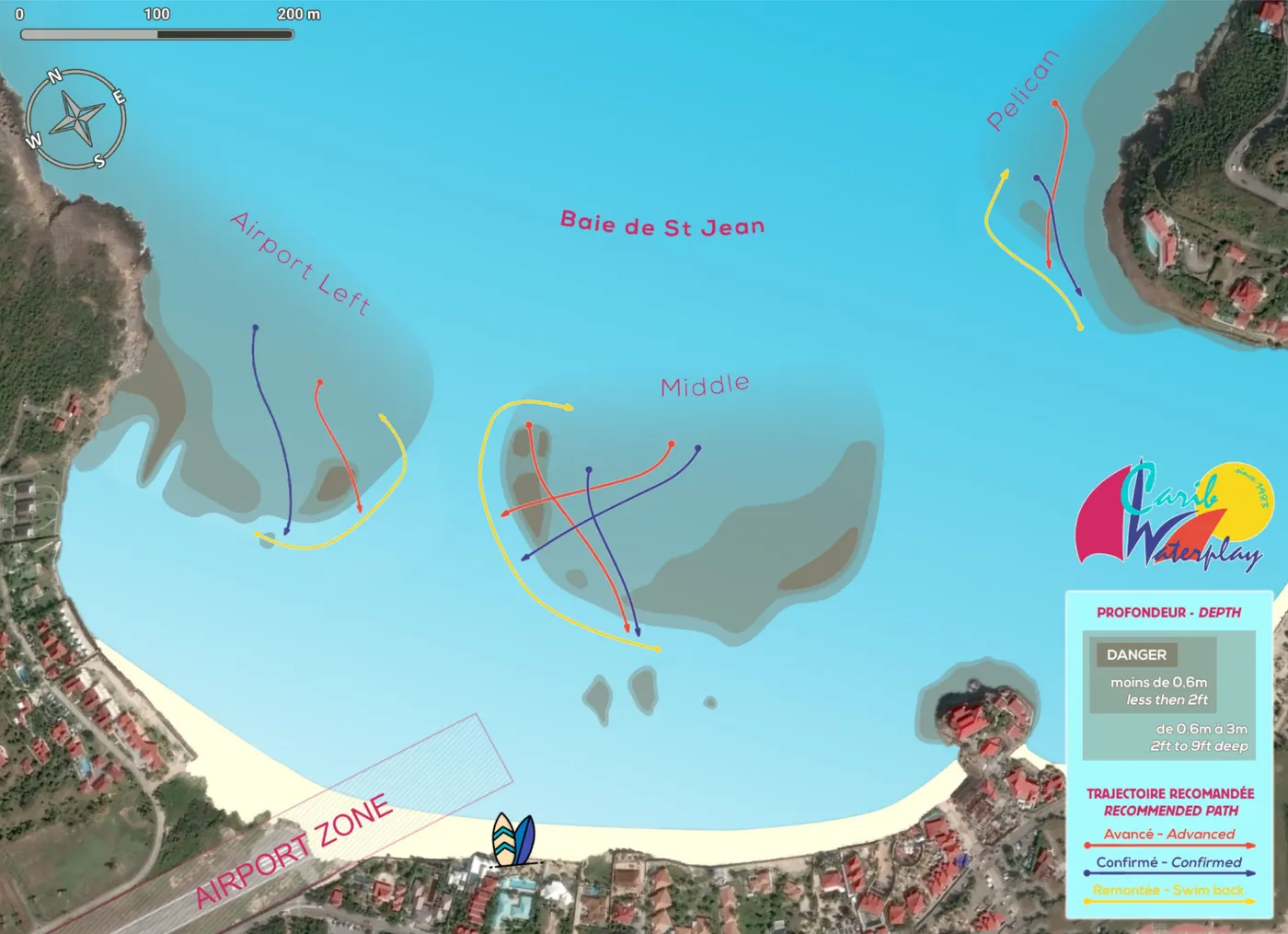
Five spots share Saint-Jean Bay, from west to east: the Left, La Passe (the pass in front of the airport), the Middle, Pélican and Coupe-Gorges. Most are reef waves: they peel sideways along the reef, hollower and more powerful, with plenty of shoulder. In the passes, waves roll straight ahead, softer and flatter.
In the bay, water comes in over the reefs and flows out through the passes: that is where you paddle back out, and where the outgoing current strengthens in big swells.
The westernmost spot in the bay, backed by the cliff on its left.
Sports: surf, bodyboard, prone foil, SUP surf, longboard; wingfoil (riding and jumping) for experienced riders.
Swell: from the northeast, east or southeast · breaks from 0.5 m, ideal 1.5 to 3 m · period of at least 6 s.
Wind: good from the southeast, south or west; bad from the northeast.
Tide: any; shallow water on the reef below 0 m.
Level: experienced only from 1.5 m, dangerous from 2 m.
Hazards: coral, sea urchins; beginners, or anyone ending up at the bottom of the spot, paddle back out through the pass.
Two left-hand take-off zones, ending on a bowl at the eastern end of the spot. Ride the wave all the way and you finish safely inside the bay. In hurricane swells with no wind, from 2 m, the wave starts at the tip of the cliff and offers beautiful barrels, all the way to the wave of the airport pass.
La Passe All levels
In front of the airport, between the Left and the Middle.
Sports: bodyboard, prone foil, longboard.
Swell: from the north, northeast, east or southeast · breaks from 0.5 m, ideal 0.5 to 1.5 m · period of at least 6 s.
Wind: good from the south, southwest, west or northwest; bad from the north, northeast or east.
Tide: best at high and rising tide.
Level: beginners welcome as soon as the wave breaks, learner foilers included; dangerous from 2 m.
Hazards: no reef, sandy bottom; strong outgoing current in big swells. In big swells the pass closes out, shutting the bay from the Left to the Middle.
A good spot to learn prone foiling and SUP foiling safely: a rolling sand-bottom wave with little power.
Middle All levels
The isolated reef in the middle of the bay.
Sports: surf, bodyboard, SUP surf, longboard.
Swell: from the north, northeast or east · breaks from 0.5 m, ideal 1 to 1.5 m · period of at least 6 s.
Wind: good from the south or west; bad from the north, northeast or east.
Tide: any; shallow water on the reef below −0.25 m.
Level: experienced only from 1.5 m, dangerous from 2.5 m.
Hazards: coral, sea urchins, shallow peak; beginners, or anyone ending up at the bottom of the spot, paddle back out through the pass.
The left starts on the western edge of the spot, on the peak, with plenty of shoulder and power; a right works in good conditions. The wave always has enough push whatever its size, but closes out from 2 m. Ride it all the way and you finish safely inside the bay.
Pélican Intermediate
It closes the bay to the east, past the Eden Rock pass.
Sports: surf, bodyboard, SUP surf, longboard.
Swell: from the north or northeast · breaks from 1 m, ideal 1 to 2 m · period of at least 7 s.
Wind: good from the southeast or west; bad from the north or northeast.
Tide: any; shallow water on the reef below −0.25 m.
Level: not for beginners, as the take-off faces the rocks; experienced only from 1 m, dangerous from 2 m.
Hazards: coral, sea urchins, shallow peak, take-off facing the breakwater; beginners, or anyone ending up at the bottom of the spot, paddle back out through the pass.
A right-hander ending on a bowl, with plenty of shoulder. Don't go straight or you end up on the rocks. Ride it all the way and you finish safely inside the bay.
Coupe-Gorges Experienced
In front of the cliff, further out than Pélican.
Sports: surf, bodyboard, longboard.
Swell: from the north or northeast · breaks from 1.2 m, ideal 1.5 to 2.5 m · period of at least 7 s.
Wind: good from the southwest or west; bad from the north or northeast.
Tide: any; shallow water on the reef below 0 m.
Level: experienced; not for beginners, as the take-off faces the cliff; dangerous from 2 m.
Hazards: coral, sea urchins and coral heads everywhere; facing the cliff.
The bigger the waves, the further it breaks from the cliff, becoming very clean and long; it can then link up with Pélican.
Seasons, tide and currents
Hurricane season (1 June – 30 November, peak August to October): a hurricane passing offshore draws the wind away and sends long-period swell, often bigger than average: great surf conditions.
Christmas winds, in winter: cold, strong northerly winds for a few days up to two weeks; temperatures drop and the swell gets choppy.
Tide: usually negligible for surfing, but watch out for large tidal ranges: on the reefs, peaks and coral heads can break the surface. Take care when foiling over reef spots.
Sand: the beach builds up in summer and erodes in winter or in big swells. The lost sand piles up in the passes, where waves may then break: great for foiling without worrying about the bottom, but it strengthens the outgoing current, especially in big swells.
Good to know
Very small tides
Tides in St Barth are subtle: the difference between high and low water (the tidal range) is usually only a few tens of centimetres. The regime is mixed, mainly diurnal: depending on the day, the sea rises and falls once or twice, with high tides of unequal height.
A small range still matters on a shallow spot like Saint-Jean Bay: a few centimetres more or less change the water depth over the reef and the way waves break on it.
Tides and watersports at Saint-Jean
Snorkelling: high tide leaves more water over the coral heads and reefs, making it easier to swim without touching them.
Launching, windsurfing and catamaran: over shallow areas, slightly higher water makes it easier to set off from the beach.
Surfing and bodyboarding: water depth over the reef changes how the wave breaks; at low tide it breaks over shallower water and gets hollower — watch out for the reef.
Either way, wind and swell matter far more than the tide at Saint-Jean: check them live on the dashboard before heading out.
Data source
Stormglass tide predictions (aggregated harmonic models calibrated on tide gauges) for 17.90° N – 62.84° W, Saint-Jean Bay. Updated daily.
Frequently asked questions
What time is high tide in St Barth today?
High and low tide times for Saint-Jean Bay are at the top of this page, in St Barth local time (UTC−4), with the 7-day forecast.
How big is the tidal range in St Barth?
Small: the difference between high and low water is usually only a few tens of centimetres. The regime is mixed, mainly diurnal, with one or two tides depending on the day.
What does the coefficient mean?
It is an index from 0 to 120 computed from the day’s tidal range, as on the dashboard: the higher it is, the more the sea rises and falls.
Does the tide matter for surfing and snorkelling?
Yes, despite the small range: at low tide, the wave breaks over shallower water above the reef; at high tide, there is more water above the coral heads to swim without touching them.